
01
What is an operational bottleneck?
A workflow is only as fast as its narrowest point.
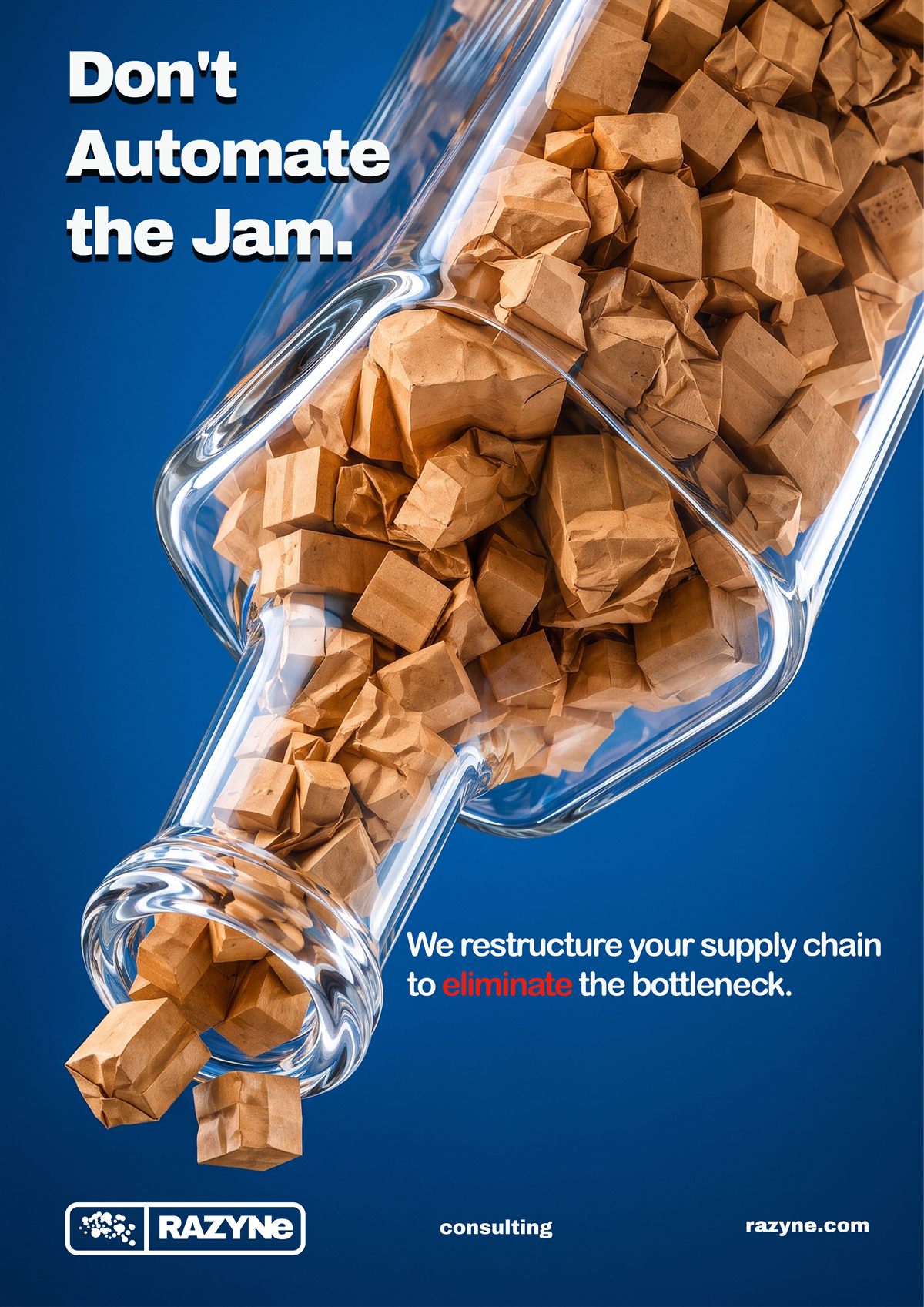
In any supply chain or business operation, a bottleneck is a point of congestion where the volume of incoming work exceeds the system’s capacity to process it. The idea comes from the Theory of Constraints. When work arrives faster than a stage can clear it, inventory, data, or approvals pile up upstream while downstream teams sit idle waiting for inputs.
Modern bottlenecks are rarely obvious physical blockages like a stalled assembly line. Most are invisible operational bottlenecks: manual data reconciliations, redundant sign-offs, disconnected software systems, and informal workarounds that quietly throttle throughput while looking normal on paper.
02
Why do bottlenecks develop?
Bottlenecks rarely appear overnight. They accumulate silently, driven by four structural dynamics.
Capacity mismatches
When upstream processes speed up without matching capacity downstream, more trucks, more leads, or faster purchase orders just move the jam further down the line.
The “cow path” problem
Most dysfunctional workflows were never designed; they evolved. A temporary patch becomes procedure, an exception hardens into a rule, and the people who knew why eventually leave.
The bullwhip effect
Small changes in demand get amplified up the chain (the bullwhip effect). During recent disruptions, containers spent 20% more time immobilized across vessels, chassis, and yards.
Information silos
Teams and partners with competing KPIs rarely share real-time capacity limits. Without end-to-end visibility, local slowdowns stay hidden until they become missed SLAs.
03
Why automating a dysfunctional process is dangerous.
Automation applied to an efficient operation magnifies efficiency.
Automation applied to an inefficient operation magnifies inefficiency.
Automation deployed over an unmapped, bottlenecked workflow does not remove the friction. It removes the human safety net. Experienced operators quietly absorb edge cases, flag incomplete records, and bridge system gaps. Replacing that judgment with rigid automation turns slow, manageable delays into high-speed, systemic failures.
-
17% → 42%
High abandonment rates
S&P Global Market Intelligence found that automation project abandonment jumped in a single year, largely because tools were deployed onto undocumented, measurement-blind workflows.
-
30–50%
Fragile deployments
Ernst & Young reports that this share of RPA scripts fail shortly after launch, because they are built on inconsistent processes that depend on tribal knowledge.
-
$881M
Cautionary scale
Zillow Offers automated its home-buying pipeline faster than its valuation model could stay calibrated. The result: write-downs, a 25% workforce reduction, and the shutdown of the unit.
Fast is not the same as fixed.
04
Why process mapping must come first.
Process mapping traces every action, decision, and handoff from input to output. It works like an operational X-ray: it shows what the organization actually does, not what its procedures claim it does. Before any software, it delivers three outcomes automation cannot.
-
It exposes waste, so you delete it instead of automating it.
Redundant approvals, duplicate data entry, and legacy checks that exist only because “the old system required it” become visible on a map. Roughly 75% of process improvement requires no automation at all.
-
It bridges the gap between documented and actual workflows.
Almost every company runs two processes: the official flowchart and the shadow workarounds that keep shipments and invoices moving. Mapping captures them, so automation does not break what keeps operations alive.
-
It forces human decisions on unresolved exceptions.
Complex workflows hide dozens of branches: years of unmade policy decisions disguised as “special cases.” Automation cannot resolve ambiguity; it hard-codes it.
If a team cannot clearly explain why a workflow operates the way it does, automating it will simply preserve confusion at scale.
05
How RAZYNE approaches operational restructuring.
RAZYNE’s methodology rests on one conviction: the map comes before the machine. Rather than forcing technology onto legacy habits, we follow four phases, so automation accelerates a clean, validated flow.
-
01
Map reality, not aspiration
On the operational floor, not in a conference room. We shadow operators, trace data handoffs, and document informal fixes.
An unfiltered current-state map. -
02
Redesign before automating
Does this approval reduce real risk, or only create delay? Can a business rule remove this exception?
Waste removed before tools are chosen. -
03
Validate, then automate
Once the process is stable manually, we automate high-volume, standardized steps with explicit rules and clean inputs.
Technology scaling a designed process. -
04
Measure and iterate
Real-time operational telemetry verifies cycle-time gains and detects secondary bottlenecks as volume grows.
Automation as an evolving capability.
Automating a jammed workflow never clears the jam; it builds a faster, costlier, and harder-to-unwind pileup. The organizations that capture lasting return from technology map reality first, redesign the flow second, and automate third. Process mapping is not overhead. It is the lowest-cost insurance against scaling an expensive failure.